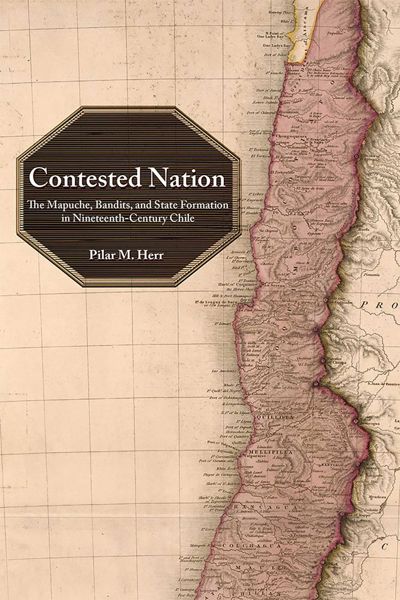
Contested Nation

The Mapuche, Bandits, and State Formation in Nineteenth-Century Chile

Description

Throughout the colonial period the Spanish crown made numerous unsuccessful attempts to conquer Araucanía, Chile’s southern borderlands region. Contested Nation argues that with Chilean independence, Araucanía—because of its status as a separate nation-state—became essential to the territorial integrity of the new Chilean Republic. This book studies how Araucanía’s indigenous inhabitants, the Mapuche, played a central role in the new Chilean state’s pursuit of an expansionist policy that simultaneously exalted indigenous bravery while relegating the Mapuche to second-class citizenship. It also examines other subaltern groups, particularly bandits, who challenged the nation-state’s monopoly on force and were thus regarded as criminals and enemies unfit for citizenship in Chilean society.

Pilar M. Herr’s work advances our understanding of early state formation in Chile by viewing this process through the lens of Chilean-Mapuche relations. She provides a thorough historical context and suggests that Araucanía was central to the process of post-independence nation building and territorial expansion in Chile.
About the author(s)

Pilar M. Herr is an associate professor of history and the coordinator for the Vira I. Heinz Program for Women in Global Leadership at the University of Pittsburgh at Greensburg.

Reviews

A significant intervention in the field that repositions established Chilean histories of the nineteenth century. . . . One aspect that I wish to highlight is her thoughtful engagement on a topic that many Chileanist and Chilean historians have avoided: race.--The Latin Americanist

In seven clear and concise chapters, Pilar Herr weaves together a wide array of primary sources. . . . Herr's rigorous empirical research, and the way that she brings it together in a cohesive and highly succinct account, make this a valuable monograph.--Joanna Crow, Hispanic American Historical Review

In seven clear and concise chapters, Pilar Herr weaves together a wide array of primary sources. . . . Herr's rigorous empirical research, and the way that she brings it together in a cohesive and highly succinct account, make this a valuable monograph.--Joanna Crow, Hispanic American Historical Review

An excellent English-language introduction to the Mapuche and their relationship to Chilean state formation during the nineteenth century.--Jesse Zarley, Canadian Journal of Latin American and Caribbean Studies

More South America

More Latin America

More History