Concise and beautifully crafted, Dancing on the Sun Stone provides a fresh and timely appreciation of the gendered dynamics of modern Mexican life. Imaginatively straddling literary genres and academic disciplines, Becker's volume deserves a place in both scholarly libraries and the undergraduate classroom.--Gilbert M. Joseph, coeditor of The Mexico Reader: History, Culture, Politics
Description
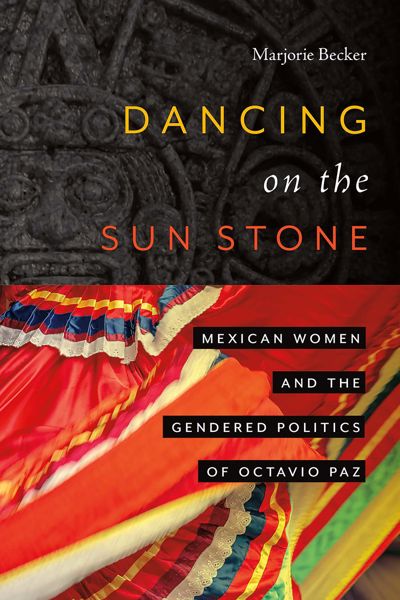
Dancing on the Sun Stone is a uniquely transdisciplinary work that fuses modern Latin American history and literature to explore women’s lives and gendered politics in Mexico. In this important work, scholar Marjorie Becker focuses on the complex Mexican women of rural Michoacán who performed an illicit revolutionary dance and places it in dialogue with Nobel Prize winner Octavio Paz’s signature poem, “Sun Stone”—allowing a new gendered history to emerge.
Through this dialogue, the women reveal intimate and intellectual complexities of Mexican women’s gendered voices, their histories, and their intimate and public lives. The work further demonstrates the ways these women, in dialogue with Paz, transformed history itself. Becker’s multigenre work reconstructs Mexican history through the temporal experiences of crucial Michoacán females, experiences that culminate in their complex revolutionary dance, which itself emerges as a transformative revolutionary language.
Reviews
At the heart of Dancing on the Sun Stone is a daring and subversive juxtaposition. Becker sets several heretofore little-known Mexican women dancing in a church one evening in 1937 alongside one well-known literary giant, Octavio Paz. Through the eyes and experience of the women, we see Paz's poetics and politics anew. The result is a luminous hybrid of history, memoir, literary analysis, gender studies, and penetrating political critique, written in a poet's lyrical prose.--James Goodman, author of But Where Is the Lamb? Imagining the Story of Abraham and Isaac

This unique and thought-provoking book is at once a marvelous social history of gender in revolutionary and post-revolutionary Mexico, an invitation to break down disciplinary barriers, and an autobiographical reflection of a great historian at work.--Jürgen Buchenau, editor of Mexico OtherWise: Modern Mexico in the Eyes of Foreign Observers