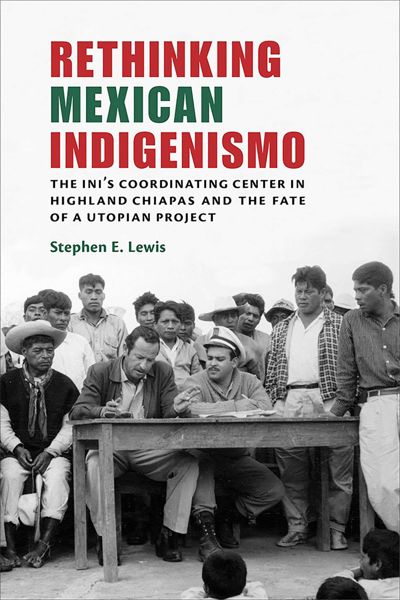
Rethinking Mexican Indigenismo

The INI's Coordinating Center in Highland Chiapas and the Fate of a Utopian Project
Description

Mexico’s National Indigenist Institute (INI) was at the vanguard of hemispheric indigenismo from 1951 through the mid-1970s, thanks to the innovative development projects that were first introduced at its pilot Tseltal-Tsotsil Coordinating Center in highland Chiapas. This book traces how indigenista innovation gave way to stagnation as local opposition, shifting national priorities, and waning financial support took their toll. After 1970 indigenismo may have served the populist aims of president Luis Echeverría, but Mexican anthropologists, indigenistas, and the indigenous themselves increasingly challenged INI theory and practice and rendered them obsolete.

About the author(s)

Stephen E. Lewis is a professor of history at California State University, Chico. He is the author of The Ambivalent Revolution: Forging State and Nation in Chiapas, 1910-1945 and the coeditor of The Eagle and the Virgin: Nation and Cultural Revolution in Mexico, 1920-1940.

Reviews

[Lewis's] approach, grounded in painstaking archival work and the author's deep knowledge of the region, yields a superb analysis of the fraught relationship among revolutionary indigenism, Mexican anthropology, and Tzeltal and Tzotzil communities.--Ben Fallaw, American Historical Review

Rethinking Mexican Indigenismo is one of but a few archive-based studies--and the first in English to focus on Chiapas--that treats indigenismo as a historical subject. Overall, Lewis's book is a fascinating portrait of how, in the author's words, 'an indigenista project that initially contemplated major structural reforms [. . .] ended up a widely criticized, largely ineffective bureaucracy that lost the support of the very people it purported to serve.'--Tribal College Journal of American Indian Higher Education

Rethinking Mexican Indigenismo is one of but a few archive-based studies--and the first in English to focus on Chiapas--that treats indigenismo as a historical subject. Overall, Lewis's book is a fascinating portrait of how, in the author's words, 'an indigenista project that initially contemplated major structural reforms [. . .] ended up a widely criticized, largely ineffective bureaucracy that lost the support of the very people it purported to serve.'--Tribal College Journal of American Indian Higher Education


Overall, Lewis has provided a rich, exhaustive account of indigenismo from the 1940s through the 1970s that will become required reading for anyone trying to understand Mexican rural politics during this time period.--Hispanic American Historical Review

More Mexico

More Latin America

More History