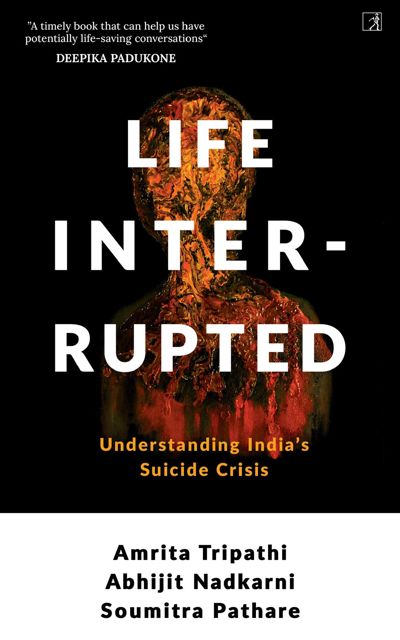
Life, Interrupted
Understanding India's Suicide Crisis
"A timely book that can help us have potentially life-saving conversations" - DEEPIKA PADUKONE, Actor & Founder, LiveLoveLaugh
“A shocking fact and huge wake-up call is that suicide is the leading cause of death for young Indians. As a country — across all our expertise and fields of interest — we need to pay closer attention, and this book urges us to do just that, with clear policy level suggestions and a call to action.” -ABHINAV BINDRA
In India we tend to have a fatalistic attitude towards suicide, tending to believe that nothing can be done to prevent it, focusing only on the politically volatile issue of farmer suicides, or periodically, when there is a death by suicide of a prominent personality or suicides in vulnerable groups (for example, students especially after Board exam results), there is a hue and cry in the popular press with opinion makers demanding immediate action.
Why should you care? Because a disproportionate number of young Indians die by suicide and these are preventable deaths.
The resulting knee-jerk reaction from policymakers is to offer some immediate solutions (appointing counsellors in colleges, etc.) which have little evidence of success. After a while, everyone forgets the issue, until the next such event and the cycle repeats itself.
This book aims to present evidence-based strategies to tackle suicide, using interviews, case studies and conversations that lay readers can make sense of, while proposing an outline of steps that policymakers, journalists and key stakeholder groups can collaborate on to provide better solutions and save precious lives in India.
Soumitra Pathare trained as a psychiatrist at Seth G S Medical College & KEM Hospital Mumbai and St Thomas’ Hospital, London. He has a doctoral degree from VU University, Amsterdam and is a Member of The Royal College of Psychiatrists, United Kingdom.
He is currently the Director of Centre for Mental Health Law and Policy at the Indian Law Society in Pune, India. Atmiyata, a rural community volunteer-led mental health service he pioneered in Mehsana, Gujarat was recently listed by World Health Organization as one of the 25 good practices for community outreach mental health services in the world.