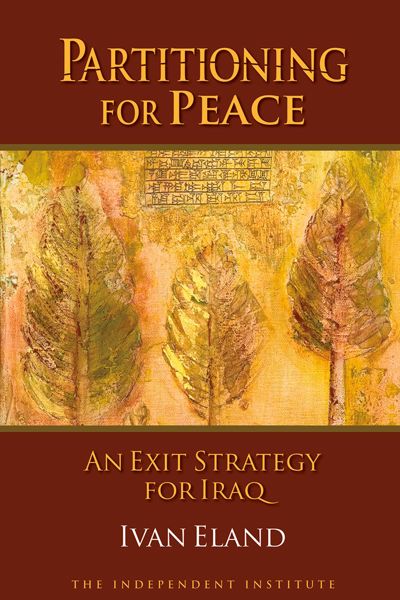
“In Partitioning for Peace, Ivan Eland writes a common sense challenge to the conventional wisdom that stability is best served by the continuation of every country currently on the map. In fact, holding countries together can be a force for instability, as Eland convincingly demonstrates in the case of Iraq. Where people overwhelmingly don't want to be part of a state, as in the case of the Iraqi Kurds, or disagree violently about the character of their state, as is true of the Iraqi Shiites and Sunnis, partition can be the more stable and peaceful outcome.”
Description
Combining a history of Iraq and its dominant sects with an acute awareness of the political machinations fomenting worldwide, this keen military analysis offers a practical exit strategy for U.S. armed forces in Iraq.
Since the history of violence in multi-ethno-sectarian states indicates that such conflicts usually resurface once an occupying force leaves, a solution to end the violence and stabilize the country must be geographically reasonable for sectarian groupings. Ivan Eland explains why partitioning, a solution that has been successful in other chaotic political situations, can be a uniquely effective political and military exit strategy for a country like Iraq.
Finally, Dr. Eland documents fifteen lessons that can be learned from previous partitions during the 20th and 21st centuries and applies them directly to the current situation in Iraq.
Reviews
“In Partitioning for Peace, Ivan Eland has identified the major pitfall facing Obama’s desire to leave Iraq. He and his foreign policy experts, as well as anyone interested in an exit strategy from Iraq should read this thoughtful analysis of the ethnic conflicts afflicting that oil rich but poor country.”
“The author of the timely book, Partitioning for Peace, foresees the eventual failure of U.S. efforts to forge an effective central government in Iraq. His alternative of partition is a way to resolve serious communal divisions with deep historical roots—latent or still violent. Though implementing partition would create formidable additional complications for Iraq it nonetheless remains an option that unresolved conflicts may force upon the country irrespective of U.S. policy.”
“Eland contends that the only workable solution in Iraq is a partition ‘into a confederation of autonomous regions or into independent successor states’ in this slim polemic. The author asserts that Iraq is an artificial state that has been held together only by ‘iron-fisted rulers’ like Saddam; wracked by ‘ethno-sectarian, tribal, and clan fissures’ it faces ‘a massive civil war’ without a negotiated partition. After a historical survey of partitions—from Poland to Yugoslavia—Eland draws 15 lessons that can be applied to Iraq. . . . A ‘unified democratic government’ in Iraq might be ‘impossible’ and partition the only viable solution as the author claims.”