Description

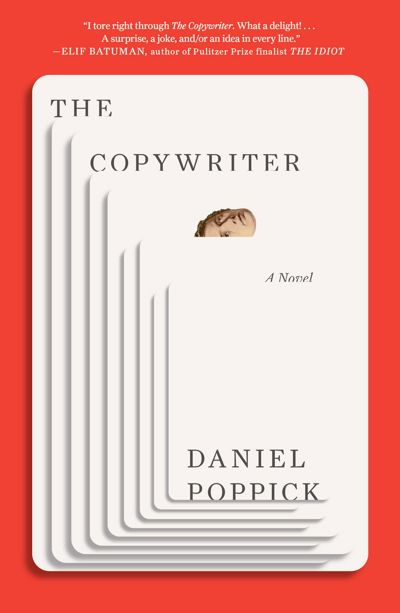
A portrait of the poet as an office worker, plumbing the depths of the spiritual gulf between art and work.

It’s the summer of 2017 and D__, a poet working by day as a copywriter at a retail start-up, can’t dispel a creeping sense of dissolution on the horizon. Whether it be the company’s new twenty-four-year-old CEO, who has more charisma than work experience, the growing distance between D__ and his longtime girlfriend, or a mounting sense of unreality in the wake of the first delirious year of the Trump administration, there’s a sense that things are speeding towards collapse—and that they’ve perhaps been unraveling for some time.

Borne along on these ambivalent straits, D__ begins to keep a notebook, filling it with everything: dreams, scenes from his own life, emails, and broadly-defined moments, both real and fictional, that he calls parables—attempts to learn from the underlying schedule of the universe, some music of the spheres that, if heard correctly, might help him finally understand his life, his art, and labor. Unfurling over the course of two years, season by season, The Copywriter circles a series of perennial questions, capturing in the process the unique absurdism of the gone-but-not-forgotten era of office culture between the Great Recession and the COVID-19 pandemic: How should an artist balance a job and life when art doesn’t fit into either category? How does one find meaning in work that is stubbornly, uncannily, comically meaningless? Does one need to find meaning in one’s labor at all? What concessions do we make for the sake of a paycheck? What does all of this do to our art, and our souls?

Utterly original and lyrically beautiful, burrowing deep into contemporary disaffection without falling under its spell, The Copywriter is a comic story in the vein of Kafka’s Jewish mysticism, following the absurd paths that office work can take us on, and the subtle ways in which seemingly mindless labor can determine our fate.
About the author(s)

Daniel Poppick is the author of the poetry collections Fear of Description, a winner of the National Poetry Series, and The Police. His writing appears in The New YorkerThe Paris ReviewThe New RepublicThe Yale ReviewBOMB, and elsewhere. He works as a copywriter and lives in Brooklyn.
Reviews

One of LitHub's Most Anticipated Books of 2026 

"Reflective...funny…This portrait of a modern-day Bartleby is a blast." Publishers Weekly

"Some of my favorite novelists are actually poets, and this now includes Daniel Poppick, who has written a stimulating and deeply pleasurable book that made me feel homesick for being a young person in New York and talking about literature with my friends, and also, weirdly, hopeful for the future. It takes the form of a set of notebooks, starting in the summer of 2017, into which a poet called D__, who daylights as a copywriter, dumps his observations, some scraps of poetry, various stories from his life, and his dreams, all with a highbrow sensibility and a winking sense of humor...A little bit Renata Adler, a little bit Ben Lerner...a little bit Maggie Nelson." —Emily Temple, LitHub

"I can barely remember the last time I read a book from beginning to end, but I tore right through The Copywriter. What a delight! A novel written with a poet’s economy—a surprise, a joke, and/or an Idea in every line. Great value! Highly recommended."
—Elif Batuman, author of Pulitzer Prize finalist The Idiot

"In this hilarious and utterly original novel of ideas, Daniel Poppick wrests words out of their day jobs and puts them back where they belong, in the realm of poetry. The Copywriter is a tour de force, drilling right through the feelings of horror and doom that attend life in our contemporary hellscape to reveal the meaning still pulsing underneath it all—like a dream waiting to be dreamt, or a bell asking to be tolled."
—Maggie Millner, author of Couplets

"The Copywriter is brilliant—a novel that reads at the pace of the thriller, with the thickness of meaning I expect from poetry. Its protagonist is a writer who is paid to make words feel dead, but who knows—even in the midst of the churning monotony of his task—that they will always find a way to live. Poppick's language is so playful, his attention to language so serious. I hung onto each clause, each clause propelled me into the next, and I emerged with a great deal of hope and inspiration, a desire to see the world with renewed curiosity, and to act in light of that curiosity, too."
—Maya Binyam, author of Hangman

More Biographical