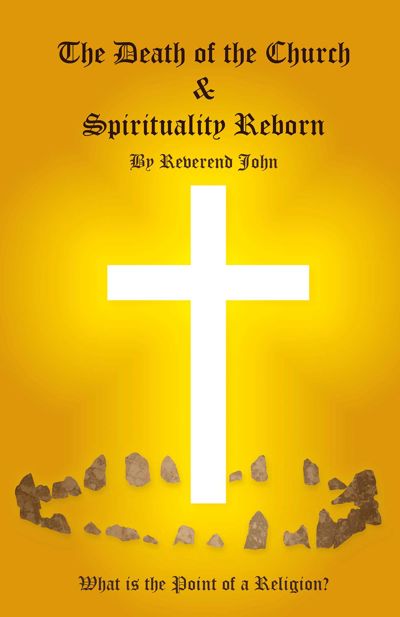
The Death of the Church and Spirituality Reborn

What is the Point of a Religion - any Religion?
Description

A controversial book which some followers of Christianity, Wicca or New Age Philosophies may find challenging, The Death of the Church and Spirituality Reborn attempts to clarify trends that are leading to the death of the Church and a desire for a more spiritual approach to the pastoral care of the nation.

Reviews

In this timely and passionate book Reverend John addresses the lack of spiritual leadership in our society. He speaks for the reality and value of spiritual experience and argues that the crusty old Church and the flaky New Age can both learn from and enrich one another. The one can find a vitality hitherto lacking, the other coherence and authority. Like his previous work on the Qabalah, this is a book to roll up your sleeves and engage with – written not necessarily for those who agree with its arguments but who share its concerns and are willing to respond to its challenge.

Mat Harvey, BBC Radio 4 / Guardian contributor, columnist

This is an unusual text from an Anglican priest identified on the cover as ‘Reverend John'. The title indicates the extensive ground covered. It is an easy read, with short chapters of only a few pages; the extent of the ground covered means few ideas are developed and the reader is left breathless. The book examines first the state of the Church, focusing on the Church of England rather than the wider world Church. He sees the Church as no longer relevant and suggests its future death stems from its failure to speak on spiritual matters, in particular about life after death. From this dying Church spirituality must be reborn.In the second part he introduces a variety of alternative spiritualities exploring the Kabala, psychic phenomena and other approaches to spirituality. The reader is led into the esoteric world as he urges that psychic abilities, including dowsing and magic, should be fostered. He advocates meditation but with no reference to its Christian forms, such as the groups linked with the World Community for Christian Meditation. His focus is on individual spiritual development and says little about how this might lead to engagement with the wider world. ‘Belief systems do not control the subconscious' which is where, he says, religious symbols belong. Throughout he refers only to the subconscious, and doesn't explain how he defines this, or how it relates to what analysts and therapists refer to as the pre-conscious and unconscious.

Peter Varney, Progressive Christianity Network, issue 21, June 2017

More Comparative Religion

More Christianity

More Body, Mind & Spirit