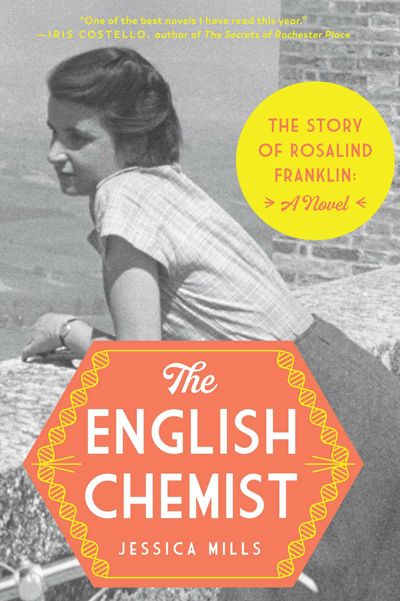
"Rosalind Franklin, biochemist and researcher, is a heroine and tragic figure to many. This fictionalized account of her life depicts the massive discrimination that she dealt with in the educational institutions and laboratories of post–World War II Europe. It was Franklin's work in micro-x-ray photography that led the way to the discovery of the double-helix shape of DNA, earning a Nobel Prize for the men who drew from it. It is readable, informative, and relatively accurate despite being fictionalized and will be enjoyed by readers who seek the deeper truth behind history's victors."
Description
The controversial story of one of the twentieth century’s most famed scientists, Rosalind Franklin, who discovered the two-chain helical structure of DNA in 1952— but was then cheated out of the Nobel Prize.
Rosalind Franklin knows that to be a woman in a man’s world is to be invisible. In the 1950s, science is a gentleman’s profession and in the years after WWII there are plenty of scientists who want to keep it that way.
After being segregated at Cambridge, then ignored and criticized in the workplace, she has no intention of being seen as a second-class scientist and throws everything into proving her worth. But despite her success in unlocking the very secret of life, the ultimate glory is claimed by the men she left in her wake.
Inspired by the true story of a woman so many tried to silence, The English Chemist is a tale of hope and perseverance, love and betrayal.
Reviews
"Mills debuts with an insightful look at the personal and professional struggles of Dr. Rosalind Franklin, whose contributions to the study of DNA went uncelebrated during her lifetime. Mills dramatizes Rosalind’s scientific prowess in intricate details and delivers insightful character work, exploring how Rosalind’s dedication to her research led to her solitary life."
Praise for The English Chemist:
"One of the best novels I have read this year."
“A poignant, compelling novel that takes us into the heart and mind of Rosalind Franklin as she struggles for recognition in a man’s world.”