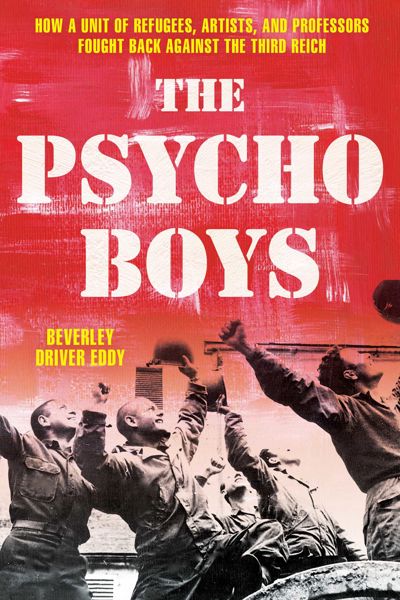
The Psycho Boys

How a Unit of Refugees, Artists, and Professors Fought Back against the Third Reich

Description

They were not your typical World War II soldiers. Most were not in particularly good physical shape, and many had trouble handling their weapons. They differed widely in their ages, politics, and skills. Many worked in academia, media, and the arts. They were a strange mix of Americans and foreign nationals, immigrants, and refugees, linked by their language skills, knowledge of Europe, and a desire to defeat the Axis. During the war, the U.S. Army trained them in psychological warfare at a secret camp on the Gettysburg battlefield and then sent them to Europe. They became known as “Psycho Boys,” a group of soldiers who have never received their due respect. In this book Beverley Driver Eddy, author of Ritchie Boy Secrets, tells their rarely heard story and argues for their importance to the Allied war effort.

At Gettysburg the Psycho Boys were taught the various skills that would be necessary in the European campaign from D-Day onward: prisoner and civilian interrogation, broadcasting, loudspeaker appeals, leaflet and newspaper production, and technical support. The 800 men were divided into four mobile radio broadcasting companies and sent to Europe to land on D-Day, fight in Normandy and at the Bulge, and participate in the conquest of Germany and the liberation of the concentration camps. Some of the soldiers operated well out in front of Allied lines and – in German – called on enemy soldiers to surrender. Others worked behind the lines, printing propaganda leaflets and making radio broadcasts.

Drawing on company histories, memoirs, and veteran interviews, this book traces the history of the 2nd, 3rd, 4th, and 5th Mobile Radio Broadcasting Companies and the individuals who served in them. For far too long, these soldiers were maligned as mere “paragraph troopers,” because they fought with words rather than bullets. As Eddy shows, the Psycho Boys hastened victory and saved countless lives by encouraging enemy soldiers to desert or surrender. Their story is an important and fascinating contribution to World War II scholarship.
Reviews

Dr. Eddy's book is another fascinating story of the Greatest Generation who fought and won World War II, this time not through bullets but through broadcasts and other techniques of psychological warfare. The book traces the formation of these psywar soldiers, many of them young Jewish men who came to the United States in the 1930s, into units that conducted operations from Africa to Normandy through the end of the war. And they trained right here on the Gettysburg battlefield in a secret site tucked into McMillan Woods. If you watched the 60 Minutes program on the Ritchie Boys, this book tells the rest of that story. Anyone interested in World War II history, psychological warfare as a military tactic, or the history of Gettysburg needs this book.

Lt. Col. Greg Howe, US Army (Retired)

The Psycho Boys is a fascinating, exciting page turner, especially about the “black” aspect of Psych Warfare, of which I assumed I was well informed. But I now realize that evidently little got out beyond the actual operatives. This revelation alone assures the book's success.

Si Lewen, Veteran, 2nd and 3rd MRB Companies

Americans fought the war against Germany in many and varied ways. The propaganda war fought by the men of the Mobile Radio Broadcast companies is one of the most fascinating. Beverley Eddy takes us on a journey with these men from their training at Camp Sharpe through combat and postwar Europe. Many of them were German-born Jews fighting the war against their former neighbors. They used the tools of radio and language to make an important impact on the war effort and ultimate victory. These powerful stories are important to our understanding of the diverse experiences of American soldiers in World War II.

Michael Rugel, Director of Programs and Content, National Museum of American Jewish Military History

Tucked away on the edge of the Gettysburg Battlefield in central Pennsylvania was tiny

Camp Sharpe where, during World War II, the US Army assembled a host of brilliant and colorful characters to fight against Nazi Germany. Historian Beverley Eddy tells the story of this remarkable band of German and Austrian immigrants who returned to Europe in 1944 as highly trained specialists in the top-secret arts of psychological warfare. The Psycho Boys delivers the tale with zest and intrigue, even as it digs deep in the historical record to uncover a lesser-known aspect of the Allied war effort. After reading Eddy’s book, you’ll be thankful for the 800 men of the four Mobile Radio Broadcasting companies that trained at Camp Sharpe. And you’ll not doubt that their service, while perhaps not making the difference between victory and defeat, shortened the war and saved untold Allied lives.

Todd DePastino, Executive Director, Veterans Breakfast Club

More History