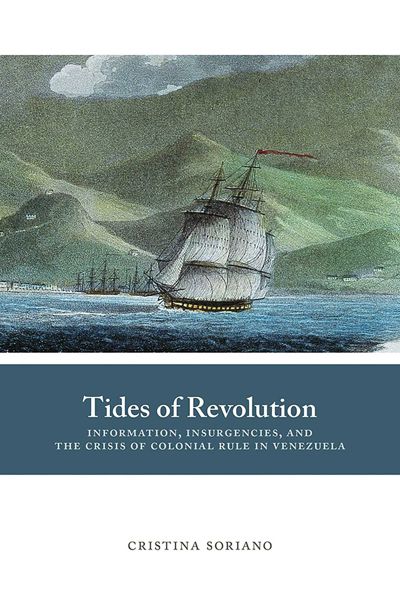
Tides of Revolution

Information, Insurgencies, and the Crisis of Colonial Rule in Venezuela

Description

This is a book about the links between politics and literacy, and about how radical ideas spread in a world without printing presses. In the late eighteenth and early nineteenth centuries, Spanish colonial governments tried to keep revolution out of their provinces. But, as Cristina Soriano shows, hand-copied samizdat materials from the Caribbean flooded the cities and ports of Venezuela, hundreds of foreigners shared news of the French and Haitian revolutions with locals, and Venezuelans of diverse social backgrounds met to read hard-to-come-by texts and to discuss the ideas they expounded. These networks efficiently spread antimonarchical propaganda and abolitionist and egalitarian ideas, allowing Venezuelans to participate in an incipient yet vibrant public sphere and to contemplate new political scenarios. This book offers an in-depth analysis of one of the crucial processes that allowed Venezuela to become one of the first regions in Spanish America to declare independence from Iberia and turn into an influential force for South American independence.
About the author(s)

Cristina Soriano is an assistant professor of Latin American history at Villanova University.
Reviews

Soriano demonstrates that coastal Venezuela suffered profound transformations in the wake of the French Revolution in the Caribbean. She thus recovers older narratives that had long connected the Latin American wars of independence to the wider late eighteenth-century Atlantic radical politics and texts.--Jorge Cañizares-Esguerra, Estudios Interdisciplinarios de América Latina

The book's major contribution (and argument) stems from late colonial Venezuela's apparent absence of 'formal centers of debate,' such as printing houses, literate societies, and bookshops. Using neglected Venezuelan, Spanish, and US sources such as contraband books, pasquinades, pamphlets, and songs, she [Cristina Soriano] reconstructs the development of what she terms 'semiliterate forms of knowledge,' including rumor, visual media, and orality.--Jesse Zarley, Latin American Research Review

The book's major contribution (and argument) stems from late colonial Venezuela's apparent absence of 'formal centers of debate,' such as printing houses, literate societies, and bookshops. Using neglected Venezuelan, Spanish, and US sources such as contraband books, pasquinades, pamphlets, and songs, she [Cristina Soriano] reconstructs the development of what she terms 'semiliterate forms of knowledge,' including rumor, visual media, and orality.--Jesse Zarley, Latin American Research Review

Cristina Soriano makes an innovative argument about the emergence of the public sphere in Latin America through a fascinating and groundbreaking study of media, culture, and political movements in late colonial Venezuela.--Edward P. Pompeian, Hispanic American Historical Review

More from series Diálogos Series

More Latin America

More History