Lomelí and Colahan's translation breathes life into Quintana's poems and prose.--American Catholic Studies
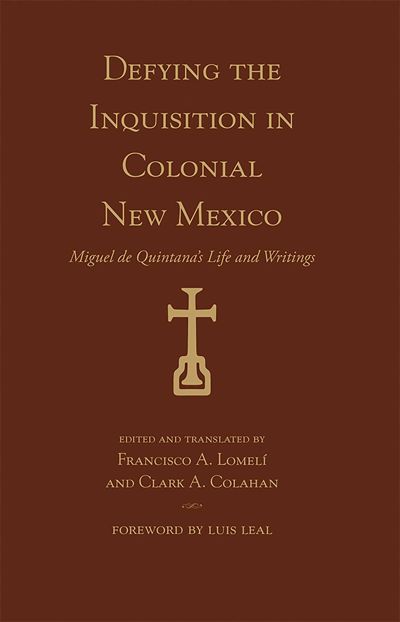
Defying the Inquisition in Colonial New Mexico
Miguel de Quintana's Life and Writings
Miguel de Quintana was among those arriving in New Mexico with Diego de Vargas in 1694. He was active in his village of Santa Cruz de la Cañada where he was a notary and secretary to the alcalde mayor, functioning as a quasi-attorney. Being unusually literate, he also wrote personal poetry for himself and religious plays for his community. His conflicted life with local authorities began in 1734, when he was accused of being a heretic. What unfolded was a personal drama of intrigue before the colonial Inquisition.
Francisco A. Lomelí and Clark Colahan dug deep into Inquisition archives to recover Quintana's writings, the second earliest in Hispanic New Mexico's literary heritage. First, they present an essay focused on Church and society in colonial New Mexico and on Quintana's life. The second portion is a translation of and critical look at Quintana's poetry and religious plays.
Lomelí and Colahan's translation breathes life into Quintana's poems and prose.--American Catholic Studies
This excellent work is a very welcome addition to the historiography of colonial New Mexico.--The Journal of Arizona History
This excellent work is a very welcome addition to the historiography of colonial New Mexico.--The Journal of Arizona History