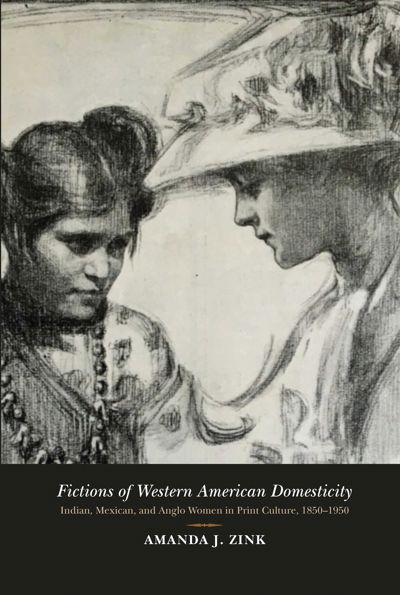
Fictions of Western American Domesticity

Indian, Mexican, and Anglo Women in Print Culture, 1850–1950

Description

This work provides a compelling explanation of something that has bedeviled a number of feminist scholars: Why did popular authors like Edna Ferber continue to write conventional fiction while living lives that were far from conventional? Amanda J. Zink argues that white writers like Ferber and Willa Cather avoided the subject of their own domestic labor by writing about the performance of domestic labor by “others,” showing that American print culture, both in novels and through advertisements, moved away from portraying women as angels in the house and instead sought to persuade other women to be angels in their houses. Zink further explores lesser-known works such as Mexican American cookbooks and essays in Indian boarding school magazines to show how women writers “dialoging domesticity” exemplify the cross-cultural encounters between “colonial domesticity” and “sovereign domesticity.” By situating these interpretations of literature within their historical contexts, Zink shows how these writers championed and challenged the ideology of domesticity.

About the author(s)

Amanda J. Zink is an assistant professor in the Department of English and Philosophy at Idaho State University. Her essays have appeared in several publications, including Studies in American Indian Literatures, Studies in American Fiction, and Western American Literature.
Reviews

This is a valuable addition to scholarship not only for its interpretations but also for its discoveries, and it will benefit scholars for years to come.--Donna Campbell, MELUS

Her work is thoughtfully attentive to the context in which these writings appeared, with convincing arguments about authorial and editorial intent grounded in a careful analysis of the advertisements that ran opposite the short stories and prescriptive articles she examines.--Western Historical Quarterly

Her work is thoughtfully attentive to the context in which these writings appeared, with convincing arguments about authorial and editorial intent grounded in a careful analysis of the advertisements that ran opposite the short stories and prescriptive articles she examines.--Western Historical Quarterly

Her work on Native boarding school publications and student writers is excellent, valuable research on which others can build. There is much to discover here.--Western American Literature

More American

More Literary Criticism

More All Other Nonfiction

More Women Authors