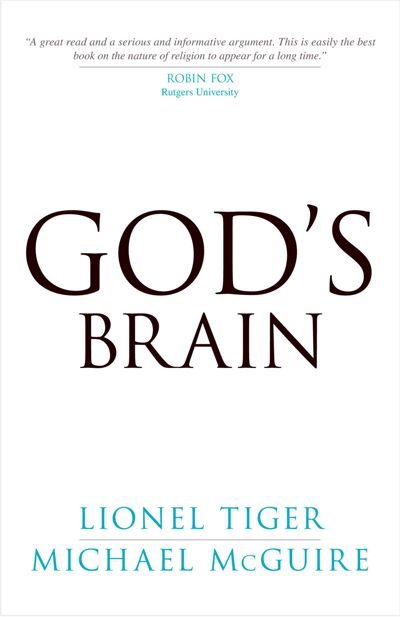
"PRAISE FOR THE ORIGINAL EDITION OF GOD'S BRAIN:“The joint effort [of two distinguished authors and scholars] is impressive. It manages to bring the experience and energy of both men together in one pithy, provocative package." --Washington Times “[The authors] rightly observe a myriad of religious-based topics and bring up fascinating discoveries of the human brain."--Sacramento Book Review, San Francisco Book Review“The authors write here for a lay audience, offering interesting anecdotes, personal experiences, and witty turns of phrase." --Library Journal“The authors' entertainingly loopy writing belies a comprehensive approach to a major fact of the human experience, and their analysis will provoke the religious and the scientific equally: a sure sign that the authors are doing something right." --SEED magazine“God's Brain is meant for a lay audience. The authors frequently express their concepts in simple, everyday terms... McGuire and Tiger invoke a wide range of social and 'hard' sciences, whether brain chemistry or the study of nonhuman primates. Although the range can make the material somewhat kaleidoscopic at times, they do not let the book become too abstract or academic... God's Brain is a welcome respite from the frenzied cacophony that too often attends discussion of religion." --BlogCritics.org“The writing style is concise, interesting, and even quite entertaining at times. What could have been a technical tome in evolutionary theory and neurobiology has been transformed into an informative book that even nonscientists can comprehend." --Perspectives on Science and Christian Faith“There is much that is coherent... in the story as told by the authors, woven together from a broad spectrum of the social and life sciences, and the ultimate survival of the authors' brain soothing idea will depend on its testability.”--Human Ethology Bulletin
Description
In the fractious debate on the existence of God and the nature of religion, two distinguished authors radically alter the discussion. Taking a perspective rooted in evolutionary biology with a focus on brain science, the authors elucidate the perennial questions about religion: What is its purpose? How did it arise? What is its source? Why does every known culture have some form of it? Their answer is deceptively simple, yet at the same time highly complex: The brain creates religion and its varied concepts of God, and then in turn feeds on its creation to satisfy innate neurological and associated social needs. Brain science reveals that humans and other primates alike are afflicted by unavoidable sources of stress that the authors describe as "brainpain." To cope with this affliction people seek to "brainsoothe." We humans use religion and its social structures to induce brainsoothing as a relief for innate anxiety. How we do this is the subject of this groundbreaking book. In a concise, lively, accessible, and witty style, the authors combine zoom-lens vignettes of religious practices with discussions of the latest research on religion's neurological effects on the brain. Among other topics, they consider religion's role in providing positive socialization, its seeming obsession with regulating sex, creating an afterlife, how religion's rules of behavior influence the law, the common biological scaffolding between nonhuman primates and humans and how this affects religion, a detailed look at brain chemistry and how it changes as a result of stress, and evidence that the palliative effects of religion on brain chemistry is not matched by nonreligious remedies. Concluding with a checklist offering readers a means to compute their own "brainsoothe score," this fascinating book provides key insights into the complexities of our brain and the role of religion, perhaps its most remarkable creation.