“A Rosetta stone for reading America and its politics today…a book that is both enjoyable as kaleidoscopic popular history and telling about our own historical moment…. Epic work.”
The Invisible Bridge
The Fall of Nixon and the Rise of Reagan
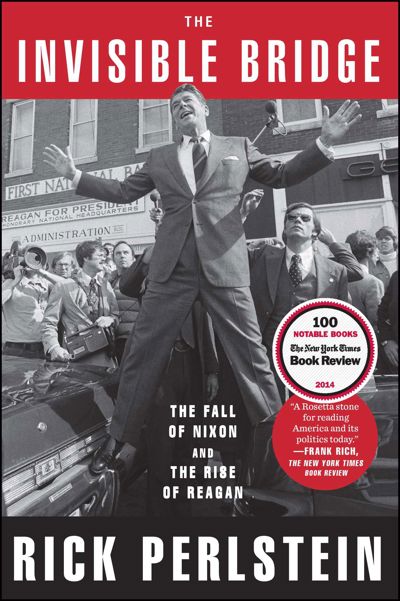
The New York Times bestselling portrait of America on the verge of a nervous breakdown in the tumultuous political and economic times of the 1970s is “a Rosetta stone for reading America and its politics today” (Frank Rich, The New York Times Book Review).
In January of 1973 Richard Nixon announced the end of the Vietnam War and prepared for a triumphant second term—until televised Watergate hearings revealed his White House as little better than a mafia den. The next president declared upon Nixon’s resignation “our long national nightmare is over”—but then congressional investigators exposed the CIA for assassinating foreign leaders. The collapse of the South Vietnamese government rendered moot the sacrifice of some 58,000 American lives. The economy was in tatters. And as Americans began thinking about their nation in a new way—as one more nation among nations, no more providential than any other—the pundits declared that from now on successful politicians would be the ones who honored this chastened new national mood.
Ronald Reagan never got the message. Which was why, when he announced his intention to challenge President Ford for the 1976 Republican nomination, those same pundits dismissed him—until, amazingly, it started to look like he just might win. He was inventing the new conservative political culture we know now, in which a vision of patriotism rooted in a sense of American limits was derailed in America’s Bicentennial year by the rise of the smiling politician from Hollywood. Against a backdrop of melodramas from the Arab oil embargo to Patty Hearst to the near-bankruptcy of America’s greatest city, The Invisible Bridge asks the question: what does it mean to believe in America? To wave a flag—or to reject the glibness of the flag wavers?
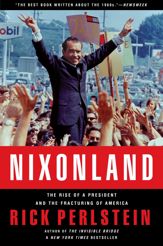
Rick Perlstein is the author of the New York Times bestseller The Invisible Bridge: The Fall of Nixon and the Rise of Reagan; Nixonland: The Rise of a President and the Fracturing of America, a New York Times bestseller picked as one of the best nonfiction books of 2007 by over a dozen publications; and Before the Storm: Barry Goldwater and the Unmaking of the American Consensus, which won the 2001 Los Angeles Times Book Award for history and appeared on the best books of the year lists of The New York Times, The Washington Post, and the Chicago Tribune. His essays and book reviews have been published in The New Yorker, The New York Times, The Washington Post, The Nation, The Village Voice, and Slate, among others. A contributing editor and board member of In These Times magazine, he lives in Chicago.
“A Rosetta stone for reading America and its politics today…a book that is both enjoyable as kaleidoscopic popular history and telling about our own historical moment…. Epic work.”
“It takes something like a miracle worker to synthesize history — especially recent history — in a way that's coherent, intelligent and compelling.... that's what [Perlstein] does in The Invisible Bridge, his best work yet... He's written something like a national biography, a deep exploration of both the politics and the culture of the late 20th century.... One of the most remarkable literary achievements of the year... The Invisible Bridge covers three years in 800 pages, but somehow, you don't want it to end... As the third book in a series, it makes clear that Perlstein, like Robert A. Caro and H.W. Brands, is one of the most impressive, accomplished writers of history in the country."
“Rick Perlstein has established himself as one of our foremost chroniclers of the modern conservative movement… Much of ‘The Invisible Bridge’ is not about politics per se but about American society in all its weird, amusing, and disturbing permutations. He seems to have read every word of every newspaper and magazine published in the 1970s and has mined them for delightful anecdotes…. It would be hard to top it for entertainment value.”
“Enthralling, entertaining…oddly charming and ultimately irresistible.”
“For Americans younger than fifty-five, the story of conservatism has been the dominant political factor in their lives, and Rick Perlstein has become its chief chronicler, across three erudite, entertaining, and increasingly meaty books…. ‘The Invisible Bridge: The Fall of Nixon and the Rise of Reagan’…finally brings into focus the saga’s leading character, Ronald Reagan…. What gives ‘The Invisible Bridge’ its originality is the way Perlstein embeds Reagan’s familiar biography in the disillusionments of the seventies.”
"’The Invisible Bridge’ is a magnificent and nuanced work because of Perlstein's mastery of context, his ability to highlight not just the major players but more important, a broader sense of national narrative.”
“Engrossing...invaluable to readers aching to find answers to why the country is so deeply polarized today.”
“A mixture of scholarly precision, outrage and wry humor.”
“This is gripping material… Perlstein's gift lies in illustrating broad political trends through surprising snapshots of American culture and media.”
“Rick Perlstein is becoming an American institution...a superb researcher and writer.”
“[A] magisterial survey of America during the mid-1970s…in many ways, The Invisible Bridge is Perlstein’s biggest accomplishment…through the accumulation of divergent storylines, a knack for finding telling anecdotes, and a frenzied pace that magnetizes Perlstein’s writing, he manages to create a vivid portrayal of this turbulent epoch…. Perlstein’s true genius lies in his ability to dig out, synthesize, and convey a jagged, multi-layered episode of history in a compelling prose…. Perlstein has again delivered a superb portrayal of American conservatism, crowning him as one of the leading popular historians of our time.”
“Perlstein has an eye for telling detail, understands the potency of American regionalism, and is shrewd about electoral technique and rhetoric. He vividly captures personalities, and his biographical chapter on Reagan is an especially masterful distillation. He is empathetic in entering into his subjects’ perspectives, gifted at recounting the sheer bizarreness of history’s twists and turns.”
“Invaluable….Perlstein is among the best young historians working today….His rich, deeply knowledgeable books…tell us almost as much about 21st century developments like the birth of the Tea Party and the current Congress' intractable gridlock as they do about the politics of the 1960s and '70s.”
“Perlstein ranges far beyond political history, in his case touching on just about everything interesting that happened in the United States between 1973 and 1976… The narrative bounces entertainingly and revealingly from high policy to low humor.”
"This is an ambitious, wide-ranging, and superbly written account filled with wonderful insights into key players…Perlstein views the rise of Reagan, with his celebration of America’s ‘special destiny’ and moral superiority, as a rejection of a more honest and practical view of our role in the world after the traumas of Vietnam and Watergate. This is a masterful interpretation of years critical to the formation of our current political culture."
“To call this book rich in anecdotes is an understatement. Perlstein adopts a you-are-there narrative that gives the reader a sense of what average Americans took in during the turbulent period from Watergate to the 1976 elections… the mini-biography of Reagan nestled in the pages is a page turner, as is Perlstein's climactic account of the nail-biter presidential nominating convention in 1976.”
“He tells a great tale, in every sense … It says a lot about the quality of Rick Perlstein's material and storytelling that more than 700 pages into his latest cinder block of ink and tree, I could still keenly relish yet another tasty fact, another aside… Also extraordinary is the writer's herculean research and the many relevant or just colorful items he uses to fill in the edges and corners and form the frame of this sprawling portrait…there's much to enjoy here.”
“Full of the tragic, the infuriating, and the darkly funny... Outstanding work.”
“Sweeping, insightful and richly rewarding…His riveting narrative continues the author’s efforts to chronicle the ascendancy of conservatism in American political life…This is a fascinating, extremely readable account of an important decade in America’s political history.”
“A compelling, astute chronicle of the politics and culture of late-20th-century America… Perlstein once again delivers a terrific hybrid biography of a Republican leader and the culture he shaped…Perlstein examines the skeletons in the Reagan, Ford and Carter closets, finds remarkable overlooked details and perfectly captures the dead-heat drama of the Republican convention. Just as deftly, he taps into the consciousness of bicentennial America. He sees this world with fresh eyes.”
“This is certainly one of the most thorough political investigations of this time frame and an important read for scholars of this period. Recommended.”
“One of America’s greatest chroniclers of the origins of the modern American right wing.”
"Magisterial."
"Rick Perlstein skillfully recounts the era that was shaped by the scandal and the way in which the sordid activities of the Nixon administration unfolded on a day-by-day basis."
"A volume on the Reagan presidency surely beckons. If it is as crammed with historical gems as this one, readers will be well served."
"The author of Nixonland is certain to generate new debates among conservatives and liberals about Reagan’s legacy."
“A painstakingly crafted illustration of the political landscape that made the improbable inevitable.”
"Magnificent…an extraordinary book, massive in scope and detail, and essential to a complete understanding of our nation’s politics. There are two contemporary historians who must be read by anyone hoping to understand American politics. One is Robert Caro, and the other is Rick Perlstein."
“Perlstein has an unmatched ability to convey the sense of an era. Even readers who didn’t live through 1970s America will feel as if they did after reading this book.”
"Perlstein’s narrative gift allows him to take Reagan’s seeming simplicity and dissecting the layers of complexity that went into crafting it."
“Expansive, rich, and masterful.”
“Perlstein’s energetic style and omnivorous curiosity about his subject make him a winning narrator… Perlstein deftly captures the wellspring of Reagan’s nature.”
“Perlstein knows so very much about American politics, some of it profoundly evocative of lost worlds and pregnant with understanding of our own… What places Perlstein among the indispensable historians of our time is his empathy, his ability to see that the roles of hero and goat, underdog and favorite, oppressor and oppressed are not permanently conferred… It requires such an empathy to reimagine the mid-’70s as a time, rather like our own, when almost nobody looking at the surface of day-to-day life was able to take the full measure of the resentment boiling just underneath it."
“The twists and turns along the way are more than worth the ride by anyone interested in high-level politics and intrigue as well as those with a bent toward the cultural side of the dreary—and violent—seventies. And let’s face it: anyone who can keep a reader’s attention in a tome that covers only three years (1973 to 1976) in over 800 pages deserves some kudos.”
“Perlstein’s achievement, both in this volume and the series as a whole, is impressive. The research is prodigious, the prose vivid, and one can only imagine what his treatment of Reagan’s presidency will bring….. Perlstein covers a great deal of ground masterfully."
“A lovely book that I paged through hungrily.”
“Perlstein’s work is important for his collection, curation, and analysis…. For those wondering where and when the seeds of the modern right wing first started to sprout, this is the place to look.”
“[A] vast and engrossing new history of the ‘70s.”
“If you haven’t read it, Rick Perlstein’s latest volume on the rise of the conservative movement, “The Invisible Bridge,” is worth a look. It focuses on the fall of Richard Nixon and the rise of Ronald Reagan. Perlstein takes us back to the chaos of the mid-1970s, remembered now, in political terms, mostly for Watergate. But he makes vivid other events of those very troubling times: gas shortages, rampant inflation, domestic terrorism and the ignominious end of the Vietnam War.”
“A rip-roaring chronicle….an exhaustive and kaleidoscopic picture of what it felt like to be an American from early 1973 when the prisoners of war began coming home from Vietnam to Ronald Reagan’s failed effort to capture the Republican presidential nomination in August 1976.”
“Filled with startling insights…. In blending cultural with political history, “The Invisible Bridge” strikes me as an obvious addition to any list of nonfiction masterpieces.”
“The Invisible Bridge is even more compulsively readable than the previous two volumes in the series.”
“A fascinating look at how the GOP was transformed in the Ford and Rockefeller years into the party it is today.”
“Witty look at the high-voltage politics and culture of the early ’70s."
“As pointed out in Rick Perlstein’s magnificent new book, The Invisible Bridge, Ronald Reagan had instituted a cult of America’s innocence.”
"Perlstein’s deep research–especially into the newspapers and magazines of that time–is artfully arranged and written."
"A masterful volume of American political history…. A rich cultural and political history of a fascinating moment in American politics.”
"A masterful volume of American political history…. A rich cultural and political history of a fascinating moment in American politics.”
“The Invisible Bridge, by Rick Perlstein, about Reagan and the rise of the conservative movement, has got that big sweep of history.”