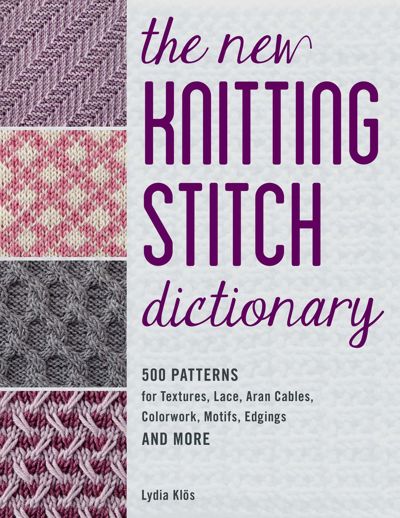
I love stitch dictionaries, so there are a lot in my collection. All the Barbara Walker and Vogue Knitting ones are there, plus the original Harmony books from Great Britain, and numerous others. So I admit to approaching The New Knitting Stitch Dictionary with some skepticism. What can this book bring to the table that I haven’t already seen?
The answer is—a little of everything. As I expected, considering my extensive library, there are a lot of stitch patterns I’m already familiar with, but then, there are quite a number of gems to be mined in this 500-stitch collection.
First, the organization of stitches in this dictionary is logical and straightforward. The stitches are categorized by type, such as cables, lace, and colorwork, which makes it relatively easy to find a particular stitch or pattern. The chapter pages have different color edges, though there is no definition (i.e., blue is the cable section, yellow is the brioche, etc.); and all swatches in the chapter use the same color yarn as the colored edge, which is a nice touch. Each stitch pattern has a clear photo and chart, and while many of the symbols are not what I would consider standard, they are all well-defined.
As noted, there are chapters for common categories of stitch patterns that one might expect, including lace, slipped stitches, cables, and colorwork; but the author throws in some interesting additions. For example, there is a chapter that covers Aran, Alpine, and Celtic cable patterns, which could be handy for Level 3 of the Master Hand Knitter program. Another chapter covers brioche and multi-row patterns (though I am still not sure what distinguishes a “multi-row pattern” from any other stitch pattern), while another includes decorative edges. Another chapter that I found even more unique was one on nupps and flower and leaf patterns. Finally, a chapter of stitch patterns using special techniques provides a smattering of some more unusual stitch patterns, including illusion knitting, mock Tunisian, smocking, knitting with beads, and an interesting variation on the chevron pattern.
The instructions for each stitch pattern are clear and concise, making them easy to follow. The accompanying swatches and charts offer a visual aid, helping to clarify the stitch’s structure and formation. All of these are offered in very small print, which can make it challenging for older eyes, and, in some cases, the diagrams could be a bit larger or more detailed, especially for more intricate stitches. Nonetheless, with a little patience and practice, most knitters will be able to master the stitches with the provided instructions and charts. Just be prepared to learn many new chart symbols to work these patterns.
At the end of the book are chapters on basic knitting techniques that are used in the various stitch patterns, plus a very brief but comprehensive overview of how to use the stitch patterns to create a finished object. I understand why this might be helpful to some who might just be picking up knitting, but it appears that the target audience for such a high-level stitch dictionary would be a more experienced knitter.
The quality of the book itself is outstanding. The pages are thick and durable, and the binding is solid, which means it can withstand heavy use without falling apart. It is, however, rather heavy, so most likely will stay in my home library—I don’t see carting this around in my knitting bag. It would really be helpful if the book were spiral bound to allow the knitter to lay the book flat when learning a new stitch pattern. I would probably take the book to an office store like Staples or Fed Ex Office to add the spiral binding myself, as I did with my Barbara Walker books, since it makes using the dictionary so much easier.
In conclusion, The New Knitting Stitch Dictionary is a somewhat surprising gem. It offers both a solid foundation of stitches that will meet the needs of many knitters, as well as some very interesting and esoteric stitches that can challenge the more experienced. The clear instructions and convenient organization also add to its value as a handy resource. I see this book as a particularly good reference for the wide variety of special stitch patterns employed in the Master Hand Knitter program. At the same time, even if you’re looking for some interesting takes on a variety of stitch patterns to supplement your knitting projects, The New Knitting Stitch Dictionary is well worth your consideration.—Celia McAdam Cahill