Description

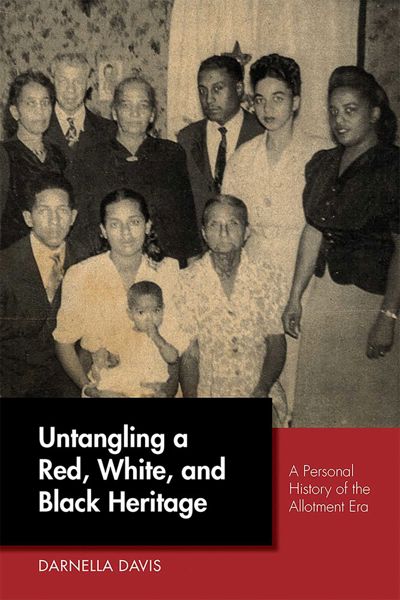
Examining the legacy of racial mixing in Indian Territory through the land and lives of two families, one of Cherokee Freedman descent and one of Muscogee Creek heritage, Darnella Davis’s memoir writes a new chapter in the history of racial mixing on the frontier. It is the only book-length account of the intersections between the three races in Indian Territory and Oklahoma written from the perspective of a tribal person and a freedman.

The histories of these families, along with the starkly different federal policies that molded their destinies, offer a powerful corrective to the historical narrative. From the Allotment Period to the present, their claims of racial identity and land in Oklahoma reveal inequalities that still fester more than one hundred years later. Davis offers a provocative opportunity to unpack our current racial discourse and ask ourselves, “Who are ‘we’ really?”
About the author(s)

Darnella Davis is a lifelong artist, writer, teacher, and scholar. Her publications have focused on education reform and equal opportunity. Born in Oklahoma and raised in Detroit, Michigan, Davis now lives in Washington, DC.

Reviews

As accessible as it is engrossing . . . Untangling a Red, White, and Black Heritage aids understanding of who the nation is, both in the past and in the present.--Brandy Thomas Wells, Chronicles of Oklahoma

Davis evocatively details family memories of the deeply problematic Dawes allotment process. . . . Family memories such as this one--highlighting the diversity of ways in which individuals chose to navigate this complex moment--demand scholarly attention.--Kendra T. Field, Western Historical Quarterly

Davis evocatively details family memories of the deeply problematic Dawes allotment process. . . . Family memories such as this one--highlighting the diversity of ways in which individuals chose to navigate this complex moment--demand scholarly attention.--Kendra T. Field, Western Historical Quarterly

Davis's book is part family genealogy, part academic text and a completely sobering look at how former black slaves of Native American tribes, and mixed-race descendants, have been treated. . . . In the end, the study is a fascinating exercise in personal identity and how we regard who we are.
--The Washington Post

More Indigenous

More History

More All Other Nonfiction

More 19th Century