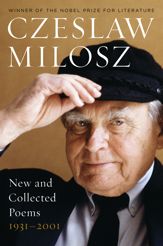
“I have no hesitation whatsoever in stating the Czeslaw Milosz is one of the greatest poets of our time, perhaps the greatest.” - Joseph Brodsky
“His work in Second Space is among his finest.” - Wall Street Journal
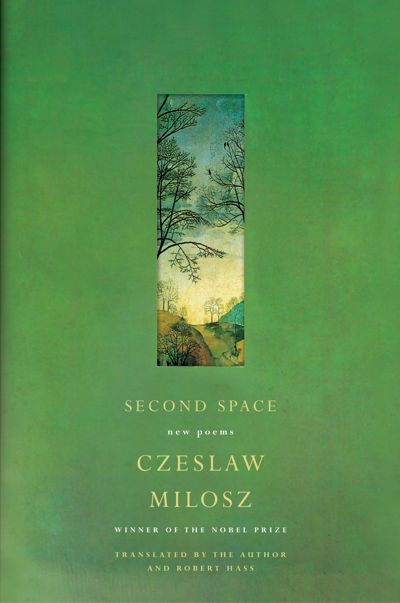
Concerned with questions of aging and mortality, A Second Space furthers 93-year-old Nobel laureate Czeslaw Milosz’s reputation as “arguably the greatest living poet” (Edward Hirsch, New York Times Book Review).
“Milosz continues exploring his own version of the meditative lyric, refusing to rest on his laurels…. Consequently, he joins the ranks of other great poets of old age, such as Robert Penn Warren and W. B. Yeats himself.”—The New York Times Book Review
A SECOND SPACE
How spacious are the heavenly halls!
Approach them on aerial stairs.
Above white clouds, there are the hanging gardens of paradise.
A soul detaches itself from the body and soars.
It remembers that there is an up and a down.
Have we really lost faith in the second space?
And they’ve dissolved, disappeared, both heaven and hell?
Without unearthly meadows how to meet salvation?
And where will an association of the damned fill its abode?
Let us weep, lament the enormity of the loss.
Let us smear our faces with coal, loosen our hair.
Let us inplore that it be returned to us,
That second space.
Czeslaw Milosz was born in Szetejnie, Lithuania, in 1911. He worked with the Polish resistance movement in Warsaw during World War II and was later stationed in Paris and Washington, DC, as a Polish cultural attaché. He defected to France in 1951, and in 1960 he accepted a position at the University of California, Berkeley. He was awarded the Nobel Prize in Literature in 1980, and was a member of the American Academy and Institute of Arts and Letters. He died in 2004.
“I have no hesitation whatsoever in stating the Czeslaw Milosz is one of the greatest poets of our time, perhaps the greatest.” - Joseph Brodsky
“His work in Second Space is among his finest.” - Wall Street Journal