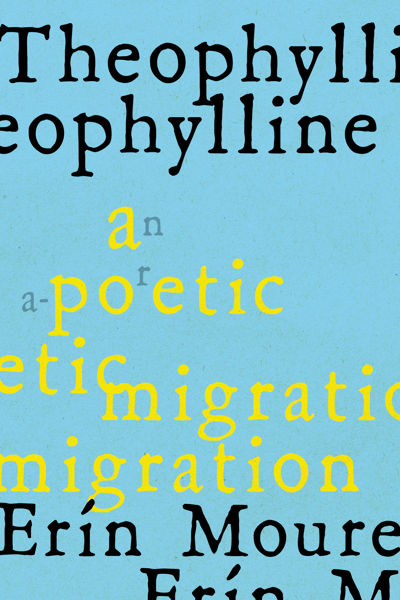
Theophylline

A Poetic Migration via the Modernisms of Rukeyser, Bishop, Grimké (de Castro, Vallejo)

Description

What is breath for? What is archive? Why write a poem, instead of... something else?

Theophylline is a work of poetry motivated by asthma, seeking poetry’s futurity in a queer and female heritage. Moure crosses a border to engage the poetry of three American modernists—Muriel Rukeyser, Elizabeth Bishop, and Angelina Weld Grimké—as a translator might enter work to translate it. But what if that work is already in English?

I looked for women who had made and were formed by
migrations, and who were in some way marked ‘qustionably’
by the socius, and I examined what I could of the forms and
shapes of their migrations—
About the author(s)

ERÍN MOURE is a poet and translator (primarily of Galician and French poetry into English) who welcomes texts that are unconventional or difficult because she loves and needs them. Among other honours, she is a two-time winner of Canada’s Governor General’s Award (in poetry and translation), a winner of the Pat Lowther Memorial Award and the Nelson Ball Prize, a co-recipient of the QWF Spoken Word Prize, a three-time finalist for a Best Translated Book Award in poetry, and a three-time finalist for the Griffin Poetry Prize. She is based in Tiohtià:ke/Montréal.

ELISA SAMPEDRÍN is undependable. Her presence, like that of the shoe, worries the book.

Reviews

"In Theophylline, the poet’s interaction with Rukeyser, Bishop, and Grimké is itself a translation ... Moure works to sensitively resuscitate erased histories." — Poetry Foundation

"Erín Moure has written a remarkable work with a title so opaque and curious as to be a signal of the fine risks she takes in this most original book … The work is multiple in genre, layered in intention, cross-hatched with connections, and it constitutes a unique study in poetry and poetics." — Poetry In Review

"A triumphant work of essai-poetry … Moure’s theorized queer poetics of disability is convincing and compelling, and the studied elements of translation and fragmentation elevate the book to a unique project." — Montreal Review of Books

"From the breath and language of others, Moure finds her own breath vocabulary, her own field of play, and in the process goes beyond mere homage into the electric field and unsettled history of these poets with whom she now breathes." — Vallum

More Poetry