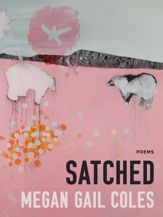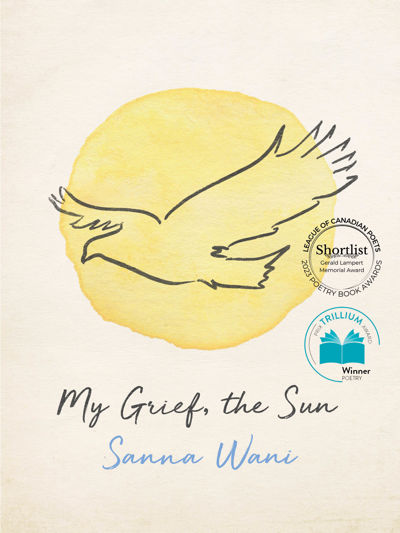
Wani has put her entire self—all her grief, all her unexpressed love, and poured it into this white and yellow bound gift for those of us who need it the most—the grief-stricken, filled to the brim with endless love.
Description
Winner, 2023 Trillium Book Award for Poetry
Finalist, Gerald Lampert Memorial Award
The highly anticipated debut collection from acclaimed poet Sanna Wani.
In Sanna Wani’s poems, each verse is ode and elegy. The body is the page, time is a friend, and every voice, a soul. Sharply political and frequently magical, these often-intimate poems reach for everything from Hayao Miyazaki’s 1997 film Princess Mononoke to German Orientalist scholarship on early Islam. From concrete to confessional, exegesis to erasure, the Missinnihe river in Canada to the Zabarwan mountains in Kashmir, My Grief, the Sun undoes genre, listens carefully to the planet’s breathing, addresses an endless and ineffable you, and promises enough joy and sorrow to keep growing.
Reviews
Beautiful and fresh ... this is a collection that finds delight in life, and its delight is contagious in the best way.
Sanna Wani’s My Grief, the Sun makes such a convincing case for astonishment as a way of life. Each poem enveloped me with so much tenderness it was as if I were the sun! The theological music that courses throughout the book was not a narrowing toward some esoteric knowledge but rather an opening toward a collective sense of enmeshment with the inscrutable world. This book is a necessary reminder that ‘there is something inside / [us] that says live.’ My Grief, the Sun is a wonder and a delight.
Mapping us through time, space, and geography, Sanna Wani’s debut collection My Grief, the Sun spins a web of various griefs and loves. As visual as it is lyrical, Wani announces herself as a poet who pushes the experimentation of form forward, taking bold risks and literally reinventing the way that we see language. ‘A mosque is always directed toward Mecca. A dome does not have orientation unless it is toward the sky,’ Wani writes, and pointing her eyes to the sky, and with incredible vision, makes even the tiniest detail visible.