“We continue to live within the intellectual shadow cast by Nietzsche.”—New York Times Book Review
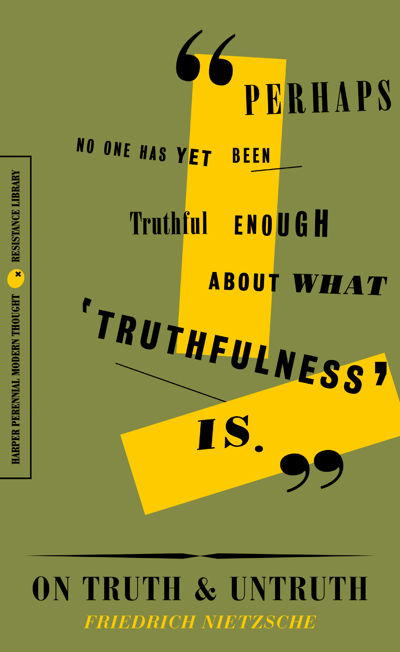
Reissued for the age of "fake news," On Truth and Untruth charts Nietzsche’s evolving thinking on the nature of truth, which has exerted a powerful influence over modern and contemporary thought. This original collection of German philosophy features the complete text of the celebrated early essay “On Truth and Lies in a Nonmoral Sense” (”a keystone in Nietzsche’s thought”—Stanford Encyclopedia of Philosophy), as well as selections from the great philosopher’s entire career, including key passages from The Gay Science, Beyond Good and Evil, On the Genealogy of Morals, The Will to Power, Twilight of the Idols, and The Antichrist.
In times of crisis, the great works of philosophy help us make sense of the world. The Harper Perennial Resistance Library is a special five-book series highlighting short classic works of independent thought that illuminate the nature of truth, humanity's dangerous attraction to authoritarianism, the influence of media and mass communication, and the philosophy of resistance—all critical in understanding today's politically charged world.
This foundational collection of critical theory explores the philosopher’s most provocative questions:
- The Value of Truth: Nietzsche’s radical questioning of whether truth is a virtue or a life-denying prejudice, an idea that resonates powerfully in the age of "fake news."
- Language and Illusion: A deep dive into the celebrated essay "On Truth and Lies in a Nonmoral Sense," which argues that what we call "truth" is merely a mobile army of metaphors.
- Genealogy of Morals: Key selections from his later works, including Beyond Good and Evil and On the Genealogy of Morals, tracing the origins of our most fundamental beliefs.
- Perspectivism: An introduction to the idea that there are no absolute facts, only interpretations—a cornerstone of his influence on postmodern thought.

































































![Some We Love, Some We Hate, Some We Eat [Second Edition] - 7 Dec 2021](https://ingress-cdn.pressreader.com/imageserver/v1/image/books/306cda81-1904-4ce5-b7be-6b12ddf16a20?width=163)


























![Sapiens [Tenth Anniversary Edition] - 18 Feb 2025](https://ingress-cdn.pressreader.com/imageserver/v1/image/books/3eaf90ec-8016-4b48-a5b5-3ca0dfdf169b?width=163)