"A learned and carefully reasoned inquiry into the workings of the mind from a Buddhist perspective... a challenging yet important work."
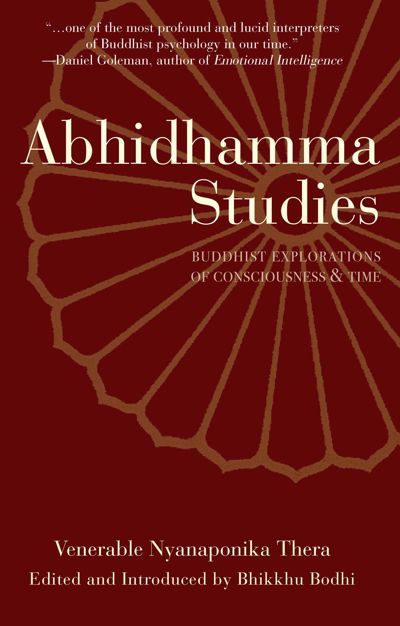
Abhidhamma Studies
Buddhist Explorations of Consciousness and Time
The Abhidhamma, the third great division of early Buddhist teaching, expounds a revolutionary system of philosophical psychology rooted in the twin Buddhist insights of selflessness and dependent origination. In keeping with the liberative thrust of early Buddhism, this system organizes the entire spectrum of human consciousness around the two poles of Buddhist doctrine - bondage and liberation, Samsara and Nirvana - the starting point and the final goal. It thereby maps out, with remarkable rigour and precision, the inner landscape of the mind to be crossed through the practical work of Buddhist meditation.
In this book of groundbreaking essays, Venerable Nyanaponika Thera, one of our age's foremost exponents of Theravada Buddhism, attempts to penetrate beneath the formidable face of the Abhidhamma and to make its principles intelligible to the thoughtful reader of today. His point of focus is the Consciousness Chapter of the Dhammasangani, the first treatise of the Abhidhamma Pitaka. Basing his interpretation on the detailed list of mental factors that the Abhidhamma uses as a guide to psychological analysis, he launches into bold explorations in the multiple dimensions of conditionality, the nature of consciousness, the temporality of experience, and the psychological springs of spiritual transformation. Innovative and rich in insights, this book does not merely open up new avenues in the academic study of early Buddhism. By treating the Abhidhamma as a fountainhead of inspiration for philosophical and psychological inquiry, it demonstrates the continuing relevance of Buddhist thought to our most astute contemporary efforts to understand the elusive yet so intimate nature of the mind.
"A learned and carefully reasoned inquiry into the workings of the mind from a Buddhist perspective... a challenging yet important work."
"Abhidhamma is a systemization of reality as it concerns the final goal the Buddha's teaching, 'liberation from suffering.' Abhidhamma Studies rigorously maps out the inner landscape of the mind to be crossed through Buddhist meditation."
"I am greatly honored to welcome this new English edition of Nyanaponika Thera's brilliant work, rendered even more valuable by the addition of an instructive and lucid introduction by Bhikkhu Bodhi."
"Delightful and thought-provoking... Essential reading for any serious student of Buddhism. Additionally, it will appeal to those interested in a wide variety of phenomenological and ontological issues... I heartily recommend reading it from cover to cover."